

Faculty of Administrative Sciences — Thamar University
The 1st International Scientific Conference (FISC 2027)
Prospects for Institutional Digital Transformation in the Finance and Business Sector towards Achieving Sustainable Development
A scientific and professional platform that brings together researchers, academics, experts, decision-makers, and practitioners to discuss the reality of digital transformation, its opportunities and challenges, and come up with applicable recommendations.
About the Conference
The world is witnessing an unprecedented acceleration in the adoption of digital technologies, leading to fundamental transformations in management, finance, marketing, production, and decision-making models. Digital transformation is no longer simply about introducing new technological tools; it has become an institutional and strategic approach that redesigns processes and services, increases resource efficiency, and enhances flexibility, innovation, and competitiveness.
As a result, digital transformation in the financial and business sector has gained particular importance for the opportunities it offers to develop financial and banking services, expand financial inclusion, improve customer experience, support entrepreneurship, and enable institutions to leverage data, artificial intelligence, and digital platforms to improve performance and decision-making.
In the Republic of Yemen, there is a growing need for realistic, phased digital transformation pathways that address the challenges of infrastructure, legislation, institutional readiness, and human resources. These pathways may also help to improve services, enhance transparency, expand access to markets and financing, and support economic recovery and sustainable development.
Based on the mission of Thamar University to serve the community, produce knowledge, and link scientific research to national development issues, the Faculty of Administrative Sciences is organizing its first international scientific conference under the title: (Prospects for Institutional Digital Transformation in the Finance and Business Sector towards Achieving Sustainable Development) to be a scientific and professional platform that brings together researchers, academics, experts, decision-makers, and practitioners to discuss the reality of digital transformation, its opportunities and challenges, and to draw up solutions and recommendations that are applicable in the Yemeni environment.
Vision
To be a leading scientific platform for knowledge production and the exchange of experiences on institutional digital transformation in the financial and business sector, contributing to more efficient, accountable, and sustainable institutions in Yemen and the region.
Mission
To provide a scientific and professional environment that brings together researchers, experts, decision-makers, and practitioners to diagnose the reality of digital transformation in the financial and business sector; analyze its requirements, challenges, and opportunities; review adaptable experiences; and propose scientific recommendations and initiatives that promote sustainable development and responsible digital transformation.
Conference Objectives
- To diagnose the current state of digital transformation in Yemeni institutions and determine the level of institutional, technical, organizational, and human readiness.
- To establish the ethical and moral dimensions of digital transformation, drawing inspiration from Quranic values such as justice, trustworthiness, benevolence, responsibility, and the preservation of rights, and translating these values into measurable policies, practices, and indicators.
- To analyze the role of digital transformation and financial technology in developing the financial and banking sector and enhancing financial inclusion, service quality, and digital trust.
- To explore the impact of digital transformation on the development of management, business institutions, entrepreneurship, marketing, e-commerce, and supply chains.
- To discuss digital governance, legislation, cybersecurity, data protection, and the ethics of using artificial intelligence.
- To strengthen the role of universities and research centers in building digital capabilities, developing academic programs, and aligning educational outcomes with labor market needs.
- To present local, regional, and international experiences and develop executive recommendations, partnerships, initiatives, and a preliminary roadmap for digital transformation in the financial and business sectors.
Conference Themes
1. Qur'anic Values and the Ethical Governance of Digital Transformation in Financial and Business Institutions
- 1.1 Governance, Transparency, and Accountability in Digital Transformation from a Qur'anic Perspective.
- 1.2 Ethics of Technology Use, Data Protection, and Privacy in Light of the Qur'anic Values.
- 1.3 Qur'anic Values in the Governance of Managerial and Algorithmic Decision-Making in the Digital Environment.
- 1.4 Applications of Digital Zakat and Waqf, and Their Role in Financing Sustainable Development and Promoting Financial Inclusion.
2. The Status and Readiness of Digital Transformation in Yemen: Digital Gap, Opportunities, and Challenges
- 2.1 Digital Transformation Readiness in Yemen: The Digital Gap, Opportunities, and Challenges.
- 2.2 Infrastructure, Legislation, Policies, and Governance in Support of Digital Transformation.
- 2.3 The Role of Domestic and International Partnerships and Public-Private Partnerships (PPPs) in Supporting and Financing Digital Transformation.
- 2.4 Leading Arab and International Experiences and the Lessons Learned for Localizing Them in the Yemeni Context.
3. Financial Technology (FinTech) and Digital Transformation in the Financial and Banking Sector
- 3.1 Digital Banking Services and Electronic Wallets, and Economic Intelligence: Their Applications in Yemen.
- 3.2 Electronic Payment Systems and Their Role in Promoting Financial Inclusion and Sustainable Economic Development.
- 3.3 Cybersecurity, Risk Management, and Digital Fraud Prevention in Financial Institutions.
- 3.4 Applications of Artificial Intelligence (AI), Financial Technology (FinTech), Regulatory Technology (RegTech), and Supervisory Technology (SupTech) in Service Development and Financial Compliance.
4. Managerial Transformation, Digital Capabilities, Entrepreneurship, and the Future of Work
- 4.1 Developing Digital Capabilities and Skills and Bridging the Skills Gap in Business Organizations.
- 4.2 Digital Leadership, Change Management, and Organizational Transformation.
- 4.3 Entrepreneurship, Innovation, and Sustainable Digital Business Models.
- 4.4 Artificial Intelligence, the Future of Jobs, and the Skills Required in the Labor Market.
5. Digital Marketing, E-Commerce, Customer Experience, and Their Sectoral Applications
- 5.1 Digital Marketing Strategies and Their Applications across Business Sectors, with Particular Emphasis on the Healthcare and Pharmaceutical Sectors.
- 5.2 E-Commerce, Digital Channel Management, and Customer Experience.
- 5.3 Applications of Artificial Intelligence and Data Analytics in Marketing and Customer Relationship Management (CRM).
- 5.4 Digital Marketing Ethics, Consumer Protection, Data Privacy, and the Promotion of Responsible Consumption.
Timeline
Conference Program
Day One — Wednesday, 27 January 2027
Day Two — Thursday, 28 January 2027
Sponsors & Partners
Tourism
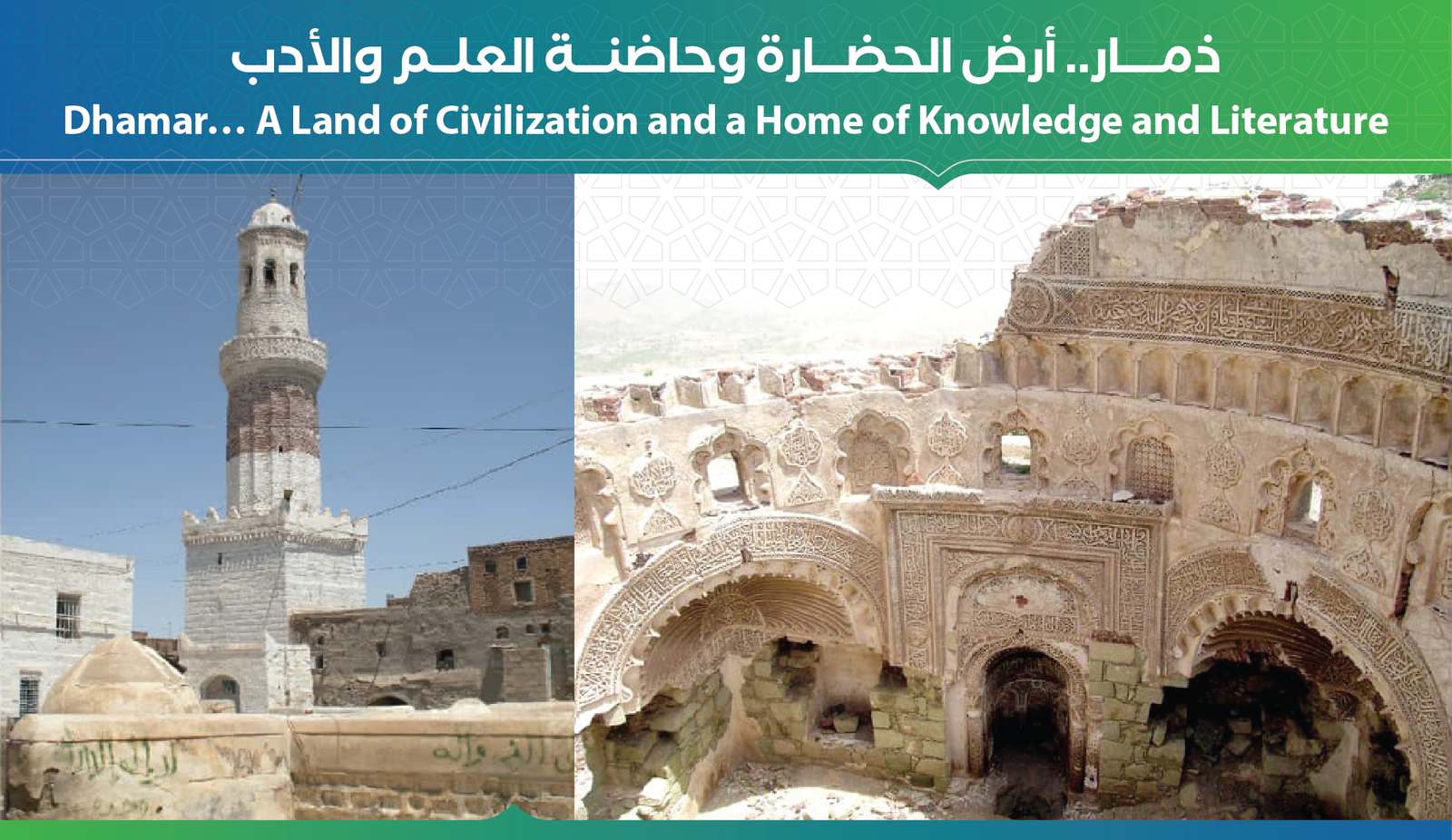
From the Legacy of Civilization to the Making of Knowledge and Administration
When Yemen is mentioned as a homeland of ancient civilizations, Thamar stands out as one of its richest chapters in history, where civilization is intertwined with place, knowledge with society, and people with the land. The governorate lies at the heart of Yemen's geography, with its towns and fertile plains set among towering mountains and broad valleys; in an environment that, through the ages, has contributed to human settlement, the flourishing of agriculture, and the growth of cultural life. Its location has also given it strategic importance, making it a meeting ground between Yemen’s regions.
Thamar's roots run deep into Yemen's ancient history, being part of the Sabaean and Himyarite civilizations. Its name is associated with several kings who left their mark on Yemen's history, earning it the reputation as the land of kings and civilization.
Its areas are rich in inscriptions, archaeological sites, palaces, and bronze statues, most notably the statues of King Thamar Ali and his son Tha'aran Yuha'anim. Thamar witnessed the flourishing of urban development, organization, and the management of land, water, and resources. Evidence of this heritage remains visible in Baynun, Masna'at Mariyah, Adhra'ah Dam, the ancient city of Hakar, and other historical sites, standing as testimony to a civilization that recognized the value of resources and excelled in organizing and investing in them. Thamar is also renowned for its natural hot springs, such as Hammam Ali, Hammam Al-Lasi, and Hammam Isbil. These springs are destinations for therapeutic purposes, particularly for healing skin conditions and rheumatism, thanks to their beneficial mineral- and sulfur-rich waters.
Yet Thamar’s greatness lies not only in its monuments, but also in the people who created them and continued the pursuit and production of knowledge throughout the Islamic eras. Thamar city embraced circles of learning in its mosques and scholarly houses. The Great Mosque stands as testimony to the deep roots of its Islamic architecture, while Al-Madrasah Al-Shamsiyyah represents one of its most prominent beacons of learning. Built in the tenth century AH, Al-Madrasah Al-Shamsiyyah became a destination for students of knowledge and a center for teaching religious and linguistic sciences, as well as scholarly and literary debates. From this scholarly environment emerged figures who left a prominent mark on Yemeni culture, foremost among them the great poet and writer Abdullah al-Baradouni, alongside Ibrahim Al-Hadhrani, Zaid Al-Mushki, Mohammed Hussein Amer, Mohammed bin Ali Al-Akwa', Ismail bin Ali Al-Akwa', and many other scholars and writers.
Building upon this enduring intellectual heritage, Thamar University emerged as a modern institutional extension of the mission of knowledge, enabling Thamar to continue its role in building people, producing knowledge, and serving society. At the heart of this institutional extension stands the Faculty of Administrative Sciences, with its departments of Accounting, Business Administration, Finance and Banking, Marketing, and Political Science. The faculty serves as an academic incubator for preparing qualified professionals capable of developing institutions and the financial and business sectors, contributing to decision-making, and utilizing knowledge and technology in the service of society.
Welcome to Thamar University, the land of civilization and the cradle of knowledge and literature—where the fragrance of the past meets the horizon of the future, and where knowledge remains a bridge connecting what was with what ought to be.